A few notes on "the Large Scale Structure" of the Universe.
Version : 0.1
Date : 10/02/2011
By : Albert van der Sel
Type of doc : Just an attempt to decribe the subject in a few simple words. Hopefully, it's any good.
For who : For anyone interrested.
Here, in a few simple pictures, we will try to depict the local- and large scale structure of the Universe.
A few used parameters explained:
- ly = lightyear = the distance light has travelled in one year (at 300000 km/s)
- pc = parsec = 3.26 lightyears = the distance light has travelled in 3.26 years (at 300000 km/s)
- kparsec = kilo parsec, Mparsec = Mega parsec, Gparsec= Giga parsec etc..
- z = measure for the "redshift". The further away an object is, the larger the "redshift" will be.
1. Dimensions of our local Galaxy (the "milkyway"):
Figure 1.

Our Galaxy (milkyway) is a spiral arm Galaxy. It's diameter is about 100000 ly. The sun is positioned in one spiral arm
located at about 8.5 kpc (about 30000ly) from the center of our Galaxy.
The disk containing the arms is relatively flat, containing dust clouds and a high variety of stars (like younger blue stars, as well as
many other type of stars like yellow stars as our Sun, white dwarfs, red giants etc..).
The milkyway is estimated to contain about 100 billion to 400 billion (100G-400G) stars.
The milkyway has a densely populated Center, and it has a spherical "halo" which has a number of smaller spherical
clusters of stars known as "globular clusters".
2. Dimensions of our "Local Group" of Galaxies:
Figures 2 and 3.
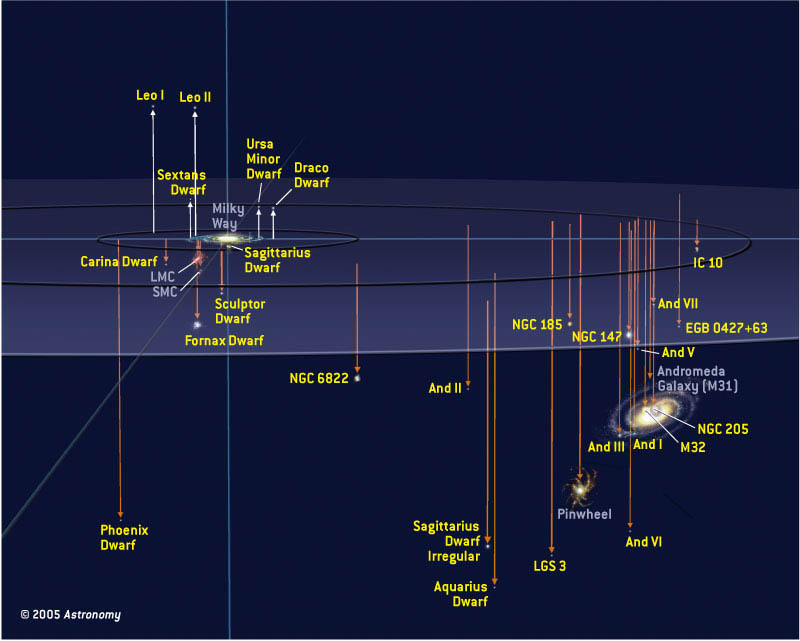

The above figures, try to give an impression of the socalled "Local Group".
Here, you see the immediate neighboorhood of our Milkyway. This neighboorhoud contains about
30 galaxies, of which most galaxies are socalled (irregular) "dwarf" galaxies. A couple of galaxies, most notably our Milkyway,
the Andromeda nebula (M31), and M33, are fairly large spiral type of Galaxies.
Note that a typical spiral galaxy is about 100000 ly accross. The Local group spans about 10.000.000 ly (10 million ly).
There are a couple of other dwarf systems, just outside that (arbitrary) volume of space, so, some folks seem
to extend the Local group somewhat, making it to contain 40-50 systems.
However large this volume of space may seem, it's still very small compared to Cluster- and Supercluster sizes.
Note that the Local Group resembles just a (small) gathering of nearby Galaxies, which does not seem to have
any spatial structure at all.
3. Dimensions of Local Clusters of Galaxies:
Figure 4.

In figure 4, you see a region of about 150.000.000 ly (150 million ly) accross. Galaxies have bundeled into "clusters".
The Local Group is at the centre of the figure. You see the 'Eridanus' cluster, the 'Virgo' cluster, and a few others.
The Virgo cluster, contains about 2000 galaxies.
Note that you still don't see the typical "filaments" and "sheets" of the Large Scale Structure.
Also note that, this whole domain of clusters is collectively called the 'Virgo supercluster'.
4. Dimensions of Superclusters of Galaxies:
Figure 5.

This time we have "zoomed out" in order to see a region of about 1.000.000.000 ly (one billion ly) across.
Now, we can cleary identify the filaments of clusters surrounding large voids, making the region to look
like a spunge or swiss cheese type of structure.
Note how strangely the walls and filaments are formed around large empty holes or voids.
In the centre of figure 5, the 'Virgo supercluster' is located, which corresponds to the whole 'area'
as show in figure 4.
Note that this region still only represents a small area in the whole of the Universe.
A peculiar region is the "Great Attractor", which is located somewhere at the Centaurus region,
about 150-250 million ly away from our Milkyway.
It seems to be a sort of a gravity "anomaly" in intergalactic space, with a mass estimated to be
tens of thousands of Galaxies (Milky Ways).
Astronomers have determined this by the motion (redshift) of the "neighbooring" superclusters,
and thus it exerts a large gravitational effect.
Also, some astronomers have determined that even our "Local Group" members, all collectively have a speed component
of about 600 km/s towards the Great Attractor.
Furher research makes it plausible that the Great Attractor is a Supercluster itself, but it is obscured
because "the line of sight" is in the plane of our own Milkyway.
5. Dimensions of the observable Universe:
Figure 6.

Now we have zoomed out to several billions of lightyears. This is what scientists today, believe the
"large scale structure" of the Universe is. Filaments of millions of galaxy clusters, galaxy superclusters (the bright knots)
span around dark, nearly empty voids.
The sponge-like structure could be explained by a network of "Cosmic Strings". But only a very small minority of
astronomers still advocate that model nowadays.
Most astronomers/cosmologists believe that extremely small "inhomogeneities" in the early phases
of the Universe, are the main cause that galaxies formed. How and why the filaments and voids formed, is still
under research. Many however, believe that "Dark Matter" could be responsible.
In the last few decades or so, it became more and more clear that stuff called "dark matter" is a very abundant type of matter in the universe.
This "dark matter" is believed to be about 26% of the total "mass-energy" in the Universe, and about 80% of all matter.
So, some even suspect that maybe the galaxies formed on a "sort of" dark matter "backbone".
This is ofcourse still a subject of intensive research.
If you like to see note on "Dark Matter" and "Dark Energy", you might use this link.