A few simple notes on "Topological Defects", like Cosmic strings, in the Universe.
Version : 0.2
Date : 10/02/2011
By : Albert van der Sel
Type of doc : Just an attempt to decribe the subject in a few simple words. Hopefully, it's any good.
For who : For anyone interrested.
Cosmic strings and other topological defects, are hypothetical objects that may be a result of symmetry
breaking models in GUT theories and cosmological models.
1. Motivations for Defects in the Universe:
1.1. Symmetry breaking:
There are several reasons why socalled "Topological defects" may exist in the Universe.
One very important reason is this: "spontaneous symmetry breaking".
In our present (cooled down) Universe, we have a number of fundamental forces (interactions) which are believed
to be unified as long as the energy is high enough. For example, just after the inflationary period,
(at the birth of the Universe), the universe cooled down to the point where symmetry breaking occurred,
and different force manifestations came into existence.
To illustrate this: Just consider a very "homogenic bowl of fluid". If you for example "rotate" it (apply an operator),
nothing changes.
Now, suppose you have just one type of force. Then no matter what set of operators you want to apply
to the system, it's very symmetric to those operators.
Regrettably this is still nerd talk. Well, here is an example that may illustrate the symmetry quite well:
Suppose you hold a ordinary magnet. If you rotate the magnet for say 90 or 180 degrees, the magnetic field lines
are totally different compared to the original position. So, this is not symmetric for rotations.
Now we heat up the magnet (not while you are holding it).
For a magnetic material, the "long range order" (magnetic domains) abruptly disappears at a certain temperature,
which is called the Curie temperature for the material. If it's just a plain iron magnet, then the temerature
is about 1043 K. All socalled line-upped Domains inside the iron dissapears, and we have a homogenic
(symmetric) situation again. So, at high temperatures this system is rotationally invariant.
And, at low temperatures the symmetry is broken.
Ofcourse, every example has flaws, and this one certainly has it's fair portion of it.
But hopefully the example conveyed the basic idea behind symmetry breaking.
"Grant Unifying Theories" (GUT's) try to "unite" the elementary (the weak, strong, electromagnetic, and gravitational) interactions
into one field theory and views the known interactions as low-energy manifestations of a single unified interaction.
In somewhat philosophical words: More is different.
The cosmological significance of symmetry breaking is the fact that symmetries are restored at high energies,
and for the extremely high energies in the early universe, we will even achieve a grand unified state.
1.2. Phase Transitions and Defects:
At the same event as decribed above, different "regions" may be formed with respect to the "background", or the vacuum.
This means that sort of isolated cells may have formed, each with their own type of vacuum and conditions.
Figure 1 illustrate those regions, separated by socalled "domain walls".
Fig 1.

Why at all, might different regions form?
A possible answer may be found in "causality" and the finite speed of light (or information).
It's probably true that causal effects in the early universe can only propagate at the speed of light c.
This then would mean that at a certain time in the early universe, regions of the universe separated by more
than a distance d=ct will "know" nothing about other regions: they are causally disconnected.
in effect: they are not close enough "to smear out" all of their properties.
So, it might be expected that different regions of the universe will fall into different values in the set of possible states
of the vacuum.
Topological defects are the "borders" of matter formed at those phase transitions in the very early universe.
These defects are likely to be in the original phase. It is assumed (and partly mathematically proven) that some
types of defects will decay rapidly, while others may persist.
Some commonly known defects are: Domain Walls (2 dimensional "sheet"), textures, and Cosmic Strings.
So it might be said, that topological defects are a posible consequence of unification theory, during the symmetry breaking.
However, from all types of defects, only cosmic strings seems to be a true candidate that might really exist.
Why?
Strings are indeed "string-like" (one-dimensional like) objects, which may span the entire Universe.
It can be shown (mathematically and from particle physics) that strings will enlarge the continous global symmetry
of the various GUT models. In such a framework, when then the symmetry is broken, instead of domain walls
the phase transitions will give rise to strings and socalled Gold-stone bosons.
So, if the defects are for real, we might expect "Cosmic Strings" instead of other types.
As another, rather "pictorial" way to see how Cosmic Strings may have formed, consider this example.
At the times the state transitions occurred, disconnected "bubbles" of true vacuum (in false vacuum) came into existence,
where in the "true" vacuum state, symmetry is broken and matter and fields came into existence.
Ofcourse, this reasoning is still speculative at this point, but it is seen by many as a possible description of the early Universe.
Fig 2.

As the bubbles grow rapidly and come in contact, there might be sharp jumps in the field values,
which might yield very compact string like "borders" of the original state of the Universe.
2. Cosmic strings and the "Large Scale Structure" of the Universe:
The "large scale structure" of the Universe, resembles some sort of "swiss cheese" structure.
Superclusters of galaxies, or large collections of galaxies, are organized in filaments with large "holes"
in between. The figure below illustrates the structure:
Fig 3.

Although the "dark matter model" seems to have become the leading theoretical paradigm for the formation of
such a structure in the Universe, some researchers still see a network of the "cosmic strings" as
precisely the common source for the observed large scale structure.
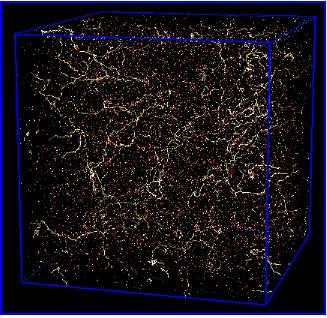
Interestingly, some studies has been done, using simulations as to how a set of Cosmic Strings would
evolve from the early universe, up to the present. Remarkably, a similar structure as the observed
large scale structure of galaxies, emerged. It is indeed quite attemting to regard the strings as a sort of "attractor"
that lined up the the clusters as the way they do. See figure 3 as a representative result of such study.
Fig 4.
However, this seems to be no longer the favourite view of most cosmologists. As said before, instead
nowadays "Dark Matter" plays a key role in the observed structure.